
Financial analysis, ready before the meeting.
Rebase reviews your P&L, balance sheet, cash flow, forecast, and operating data as the numbers change. Ask what needs attention. Get the drivers, source records, and draft commentary Finance needs to act.
See Rebase on your data


One finance workspace for every management question.
Leadership should not have to wait for Finance to rebuild the numbers every time a question comes up. Rebase prepares the answer from the financial and operating context your team already trusts.
Finance reviews the explanation, applies judgment, and decides what happens next.
Ask what leadership needs to know.
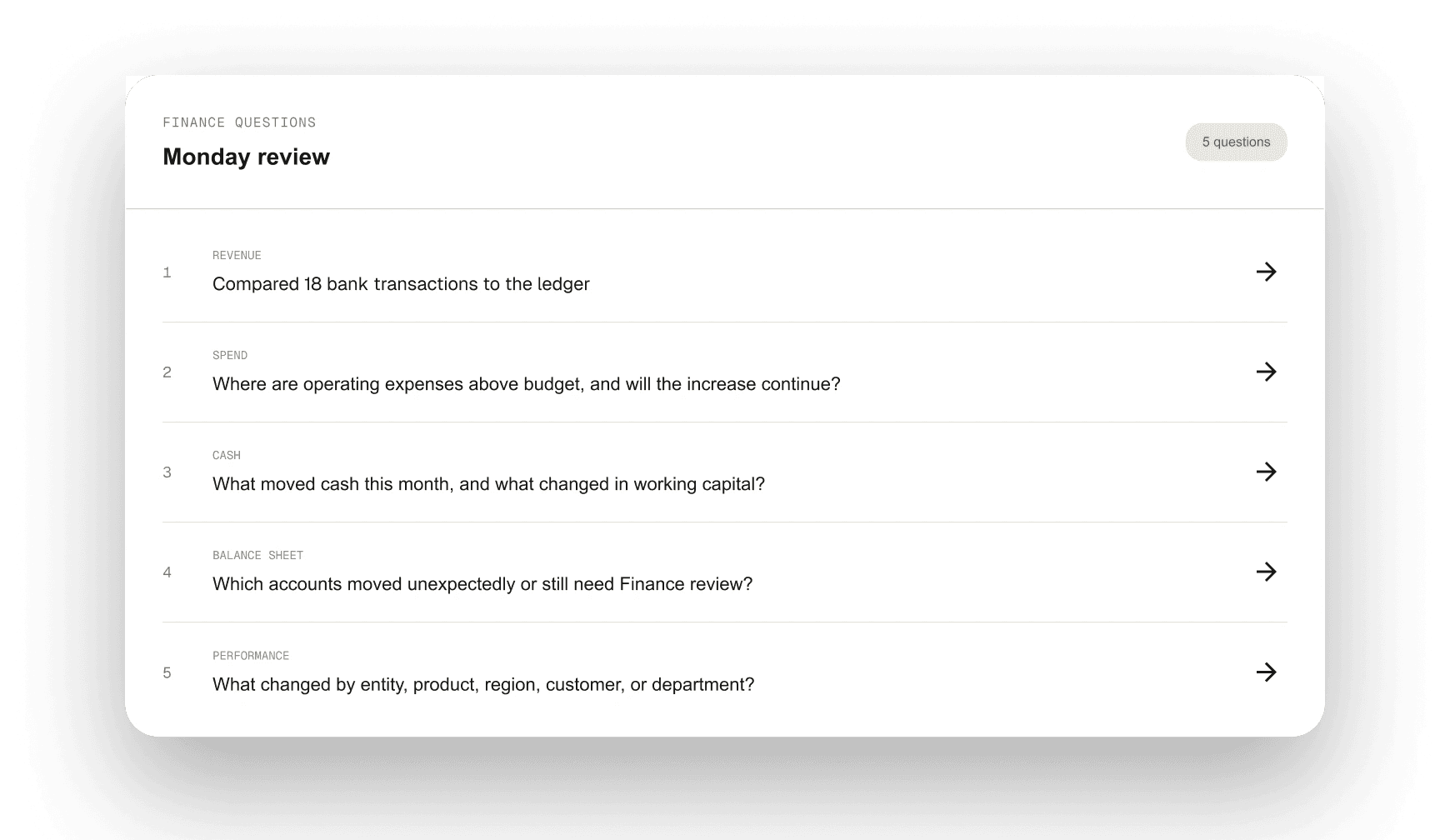

Trace the movement through the business.
Give Finance the answer, evidence, and decision required.

The analysis behind every management review.
Start with the recurring question closest to the close. Expand after the data, definitions, and output are reliable.
1
P&L analysis
Revenue, gross profit, operating expenses, EBITDA, and the business activity behind each movement.
2
Balance-sheet analysis
Account movements, working capital, unusual balances, and items that require Finance review.
3
Cash-flow analysis
Cash movement, liquidity, runway, and the operating decisions affecting cash performance.
4
Budget and forecast
Actuals against budget, forecast, and prior periods across the dimensions Finance uses.
5
Revenue and customers
Pipeline, contracts, billing, usage, expansion, contraction, churn, and forecast timing.
6
Cost and profitability
Spend, headcount, vendors, products, entities, and the factors changing profitability.
7
KPIs and unit economics
Financial and operating measures reviewed together using the company's definitions.
8
Management reporting
Reviewed findings, commentary, and follow-up answers for leadership and the board.
Spend less time assembling the answer.
Rebase handles the repeatable investigation and preparation. Finance stays responsible for the definitions, judgment, and final decision.


From management question to reviewed finance brief.
Begin with one recurring review. Keep the workflow narrow until the answers and evidence are reliable.
Connect the approved data
Financial records, plans, forecasts, operating data, and supporting documents.
" height="30px" id="JLSlfqamx" transform="translate(5 5)" width="30px"/></svg>)
Define the analysis
Calendar, metrics, versions, materiality, dimensions, calculations, and reviewers.
Prepare the answer
Movements, drivers, evidence, commentary, open questions, and next actions.
Finance reviews
People validate the evidence, apply judgment, approve the brief, and own the decision.
Built around the records already used in your close.
Rebase works with the financial data, operating records, documents, and workpapers required by the workflow. Your ERP remains authoritative.


What finance teams ask before the first close.
What does Rebase automate in the month-end close?
Is Rebase another close checklist?
Does Rebase replace our ERP?
Can Rebase prepare and post journal entries?
What happens when Rebase is uncertain?
Can we keep our existing workpapers and close process?
How does Rebase keep Finance in control?
Can we begin with read-only access?
How does Rebase keep Finance in control?
Will our auditors be able to review the work?
How does Rebase handle finance data and AI models?
How do we get started?



Put it on Day Zero.
See Rebase in action
Autonomous finance, without giving up control.
© 2026 Rebase. All rights reserved.