

A delayed shipment triggers a cascade that no single system can see. The TMS has the carrier status. The WMS has the dock schedule. The ERP has the customer order. The carrier has the ETA in an email your team hasn't read yet.
Your operations team is the integration layer, chasing updates across 6 tabs and a phone. AI that just answers questions about shipments won't fix that.
Systems in the average logistics operation. TMS, WMS, ERP, carrier portals, telematics, yard management, EDI, scheduling, and the spreadsheet that connects them.
Of logistics professionals say exception management is still manual. Phone calls, emails, spreadsheets. The exception data exists in the systems. The coordination doesn't.
Annual cost of detention and demurrage in the US alone. Most of it caused by miscoordination between carrier, shipper, and facility systems.
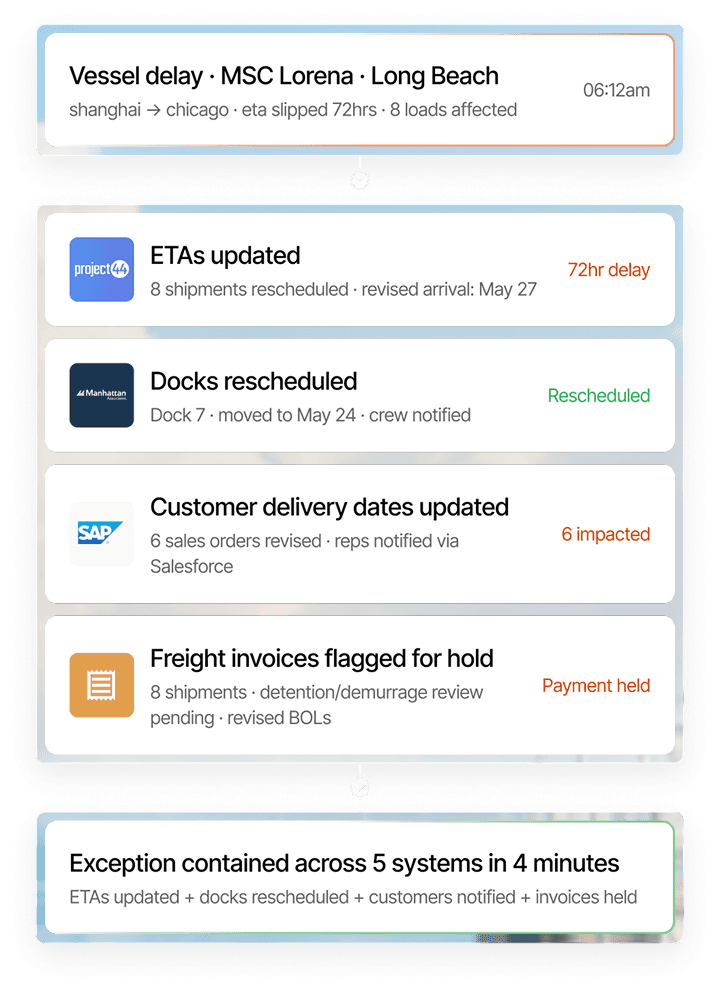
Vessel delayed at Long Beach. Agent pulls the updated ETA from the carrier, adjusts the dock schedule in the WMS, updates the delivery date in the ERP, notifies the customer, and flags the freight invoice for hold. One pass. Five systems.

Carrier tracking and delay detection
Check in with carriers at milestones, collect live ETAs from carrier APIs and telematics, flag exceptions the moment they surface.
Dock scheduling and receiving coordination
Align carrier arrival with facility availability. Confirm the slot. Eliminate scheduling conflicts between TMS and WMS.
Inbound freight exception handling
Late shipment cascades into receiving, inventory, and customer delivery. Agent adjusts the WMS, updates the ERP, and notifies downstream teams.
Customs and duties tracking
Monitor clearance status, flag holds, push updates to procurement and finance. No more checking the customs portal manually.
CARRIER COMMUNICATIONS

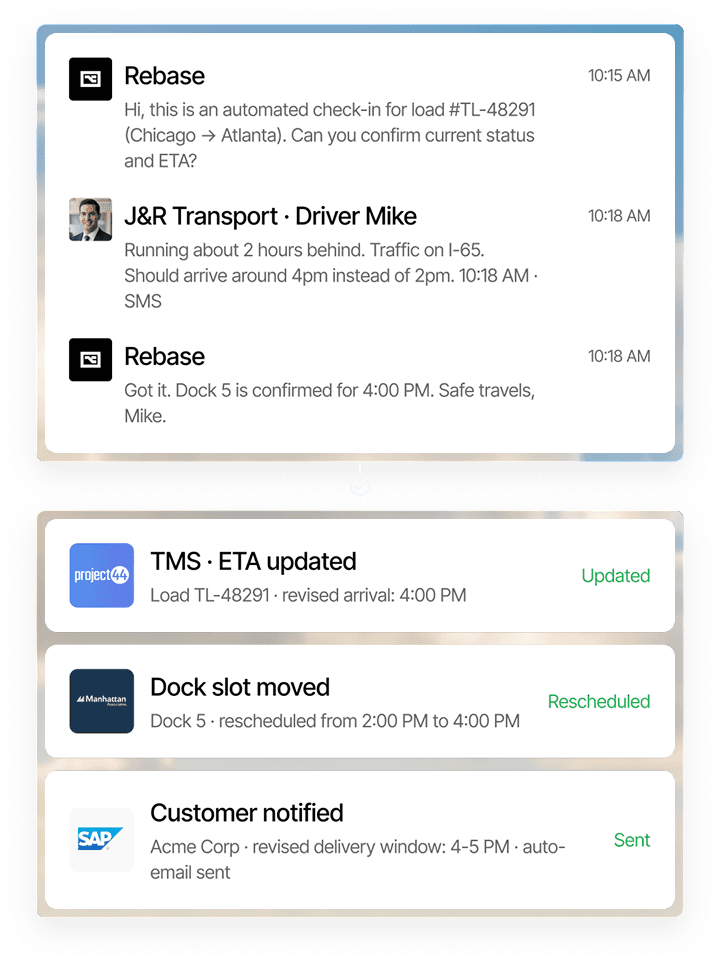
Your team makes 200 carrier check-in calls a day. The agent handles the outreach via email, SMS, or phone. Collects the ETA. Updates the TMS. Adjusts the dock schedule. Notifies the customer. The carrier communication is one step. The cross-system update is the real work.
Milestone check-ins
Automated outreach at pickup, in-transit, and delivery milestones. Collect live status via email, SMS, or voice. Update TMS and WMS in real time.
Delay escalation and resolution
Carrier reports delay. Agent collects revised ETA, updates all downstream systems, notifies the customer, and escalates to dispatch if SLA is at risk.
Appointment scheduling
Coordinate delivery appointments between carrier and facility. Check dock availability in the WMS, confirm with the carrier, send the confirmation.
Multilingual carrier support
Communicate with carriers in their language across all channels. Spanish, Portuguese, Mandarin. No separate language teams.
Your freight audit team re-checks every invoice against the rate con and the BOL. Agents pull the rate from the TMS, the weight and stops from the BOLs, and the carrier invoice from the portal. Three-way match. Discrepancies flagged. Accessorials challenged.


Freight invoice 3-way match
Match rate confirmation, BOL, and carrier invoice. Flag overcharges, incorrect accessorials, weight discrepancies, and duplicate billings.
Accessorial charge validation
Detention, lumper fees, fuel surcharges. Agent checks each accessorial against contract terms and actual events in the TMS.
Carrier payment scheduling
Optimize payment timing based on terms and QuickPay discounts. Route approved invoices to AP with full documentation attached.
Duplicate billing detection
Same load billed twice, or billed by both broker and carrier. Agent catches it before payment clears.
CARRIER PERFORMANCE & COMPLIANCE


You run 50+ carriers across 12 lanes. On-time performance, claims history, invoice accuracy, communication responsiveness. The data is scattered across TMS, claims systems, and AP. Agents pull it all together into one scorecard, updated after every load.
Carrier performance scoring
On-time pickup, on-time delivery, claims ratio, invoice accuracy, responsiveness. Scored per lane, per carrier, updated continuously.
Contract compliance monitoring
Track committed volumes vs actuals. Flag carriers under-performing on lane commitments. Alert before contract renewal windows.
Lane cost analysis
Compare all-in cost per lane across carriers. Include accessorials, detention history, and claims. Not just the line haul rate.
New carrier onboarding
Collect insurance certs, W-9s, authority verification, safety scores. Track progress. Flag incomplete submissions.
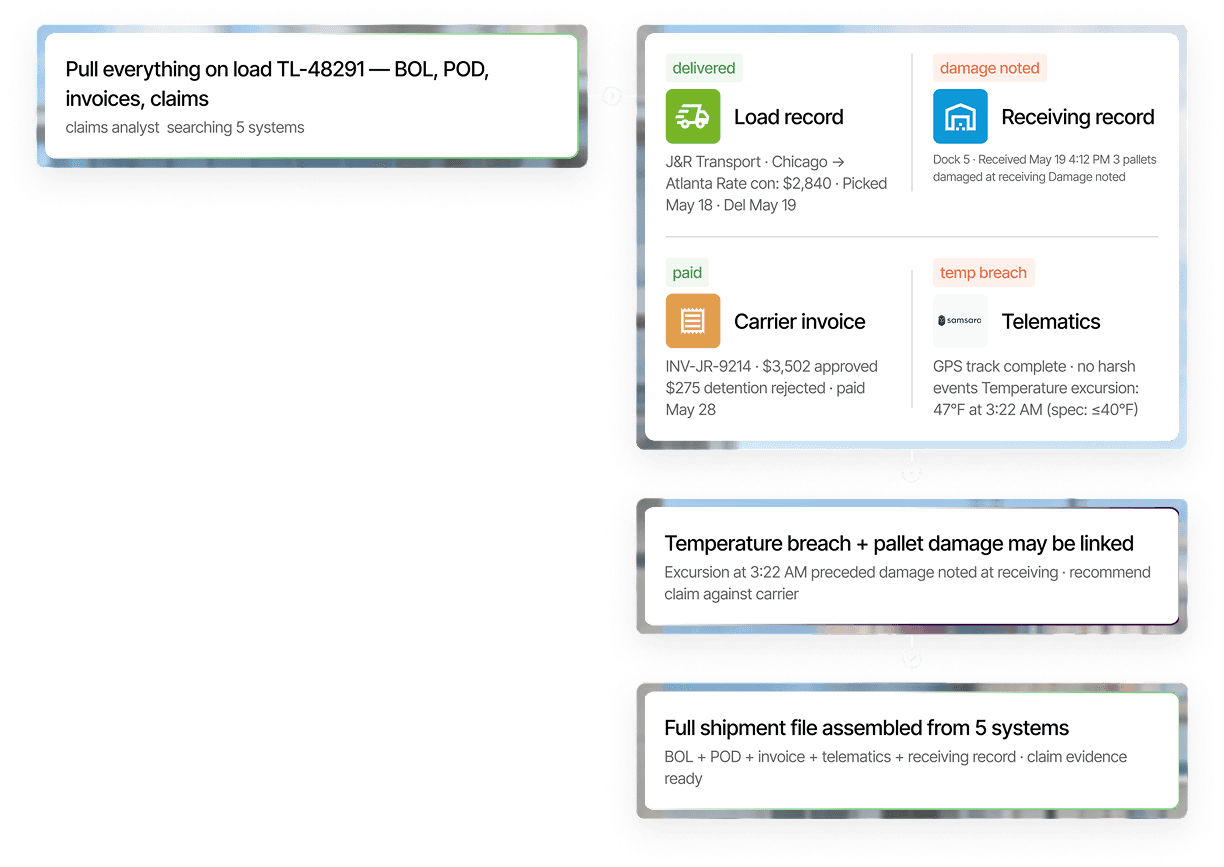
Auditor asks about a shipment from 6 months ago. Your team checks the TMS, then the WMS, then the carrier portal, then the claims file. Agent pulls it all in one search: BOL, POD, rate con, invoice, claims history, driver records.

Shipment history lookup
Full shipment profile: BOL, rate confirmation, POD, carrier invoice, claims, accessorials. Every document from every system in one result.
DOT and safety compliance
Carrier authority status, insurance expiration, safety scores, driver qualification files. Pulled from FMCSA, carrier records, and your onboarding system.
Claims investigation
Damage claim filed. Agent pulls the BOL condition notes, POD signatures, telematics data, and temperature logs. Full evidence chain for the claim.
Customs and trade compliance
Pull HTS codes, commercial invoices, certificates of origin, and customs clearance status across shipments. Ready for audit.
Your engineer learns your freight network
Which lanes, which carriers, which systems handle what. How exceptions flow between dispatch, operations, and finance. They understand your network before connecting anythinag.
They connect MercuryGate, Manhattan, SAP, carriers
Read-only first. Context graph builds across your TMS, WMS, ERP, carrier APIs, and telematics. Your IT team reviews every connection.
Agents respect your dispatch rules
Every agent operates within your existing carrier selection, approval workflows, and rate thresholds. Sandbox first. Production after your team signs off.
One engineer. Not a systems integrator.
No $3M Accenture project. No 18-month timeline. One implementation engineer, one platform, live in weeks. Running real freight operations from day one.
Agents that audit invoices, score carriers, and coordinate exceptions need access to your most sensitive operational and financial data. Rebase runs inside your VPC. Full audit trails on every action.
REBASE DEPLOY • YOUR-VPC
$
rebase init --byoc
>
provisioning in vpc-prod-eu-west-1
✓
control plane installed
✓
data plane bound to your KMS
✓
audit controls enforced
$
rebase status
Built for regulated freight operations.
Control plane, data plane, model gateway. All inside your perimeter. Every agent action auditable. Zero data retention available.
AWS
AZURE
GCP
ON-PREM
AIR-GAPPED
Full audit trail on every action
Every invoice audited, every carrier scored, every exception handled. Logged, append-only, streamable to your SIEM.
Human-in-the-loop on sensitive actions
Agents that approve freight payments, dispute charges, or reschedule high-priority loads require human approval. Your existing rules, enforced by the platform.
Model-agnostic with data controls
Route agents to any model. Carrier rates and contract terms are masked before hitting the model when required. Switch providers without touching agent logic.
Sandbox-before-production
Every agent runs in shadow mode against real freight data with write-access disabled. Your operations team reviews and promotes to production.
SOC 2
BYOC
ZERO DATA RETENTION
C-TPAT
FMCSA
SOX GDPR
FAQS

" height="24px" id="W5lcXBfNC" width="24px"/></g></svg>)