

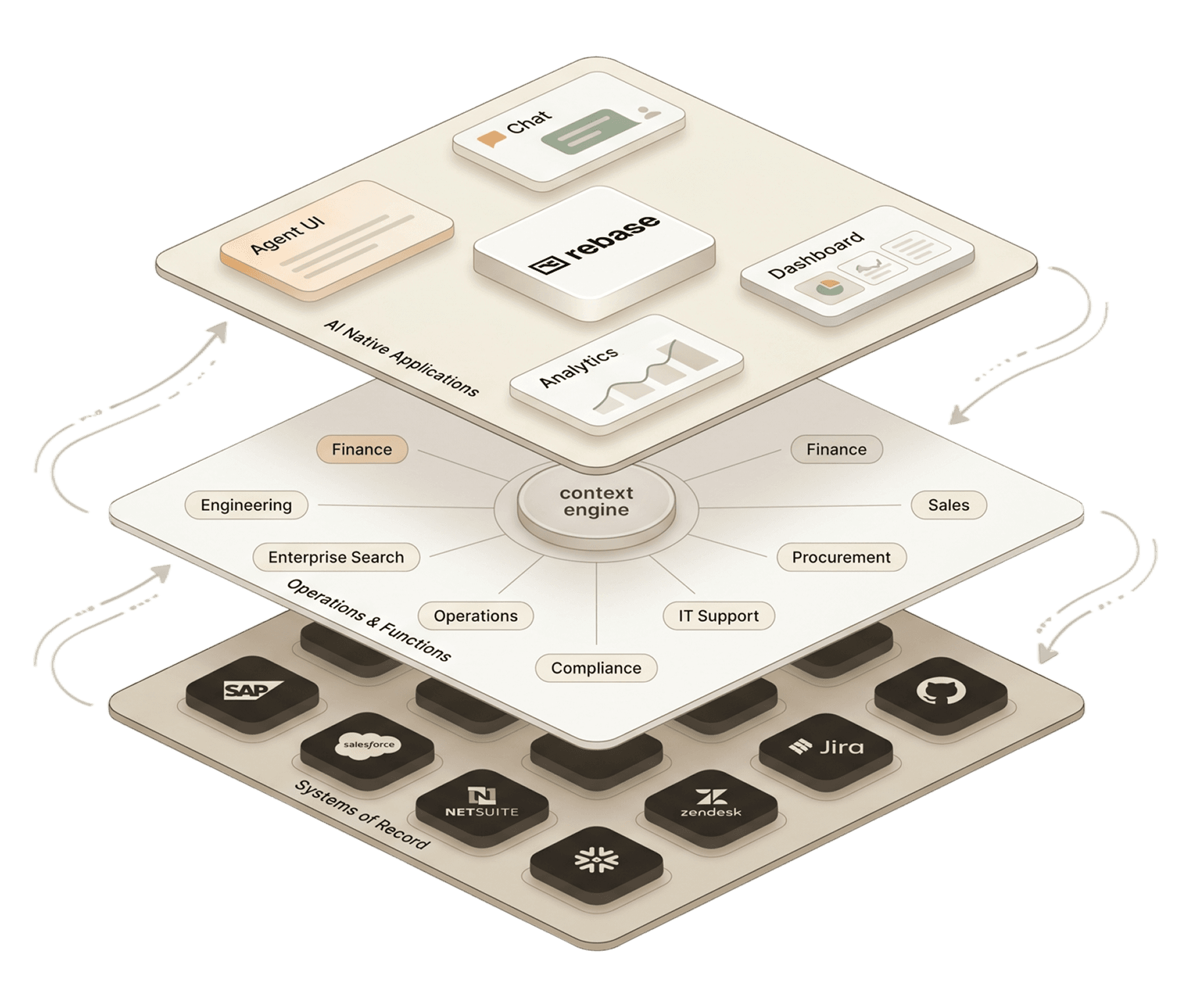
Rebase agents pull live context from every system your IT team runs on. ServiceNow, Jira, PagerDuty, Datadog, Dynatrace, Okta, Intune, AWS, Azure, GCP, Slack. Then they do the work. Tickets resolved. Alerts correlated. Assets reconciled. Spend optimized.
Not a chatbot on top of ServiceNow. The actual operational work.


IT SERVICE DESK

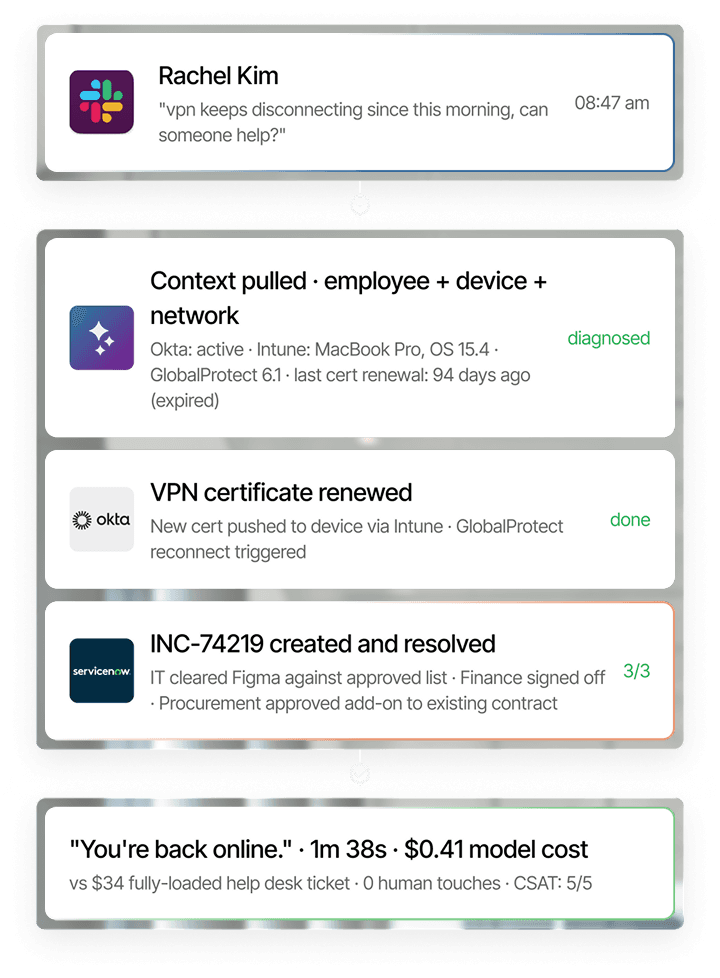
Password resets, software access, VPN issues, how-do-I questions. 40 to 60% of help desk volume is repetitive L1 work. Agents intercept the request in Slack or Teams, pull the employee context from Okta and ServiceNow, and resolve it end to end. The ticket never opens.
Conversational resolution in Slack
Employee asks in natural language. Agent resolves password resets, provisions software, answers policy questions. No form. No portal. No ticket.
Action in the source system
Okta group assignment. Intune device enrollment. ServiceNow ticket creation and closure. AD password reset. The agent executes, not just replies.
Identity-verified before any action
SSO check, role verification, manager approval where policy requires. Every action authorized against your access matrix before execution.
Escalation with context, not from scratch
When the request needs a human, the agent hands off with the employee profile, the actions attempted, and the diagnostic data. No re-explanation.


IT ops teams drown in alert noise from 20+ monitoring tools. Correlating events, finding root cause, and mobilizing responders takes hours. Agents correlate the noise into actionable incidents, surface probable root cause, and trigger remediation before the war room convenes.
Cross-tool alert correlation
PagerDuty, Datadog, Dynatrace, CloudWatch, Prometheus, Splunk. Thousands of alerts collapsed into a handful of incidents with shared root cause.
Root cause surfaced with evidence
Not "something is wrong." The specific service, the specific change, the specific deploy. Cited from the monitoring data, the change log, and the dependency graph.
Auto-remediation for known patterns
Pod restart. DNS cache flush. Config rollback. Connection pool drain. Agent matches the pattern to a runbook and executes. Human notified, not paged.
War room assembled with context
When the incident needs humans, the agent opens a Slack channel with the timeline, the blast radius, the on-call team, and the remediation options. No 20 minutes of "what do we know."
ASSET MANAGEMENT & CMDB

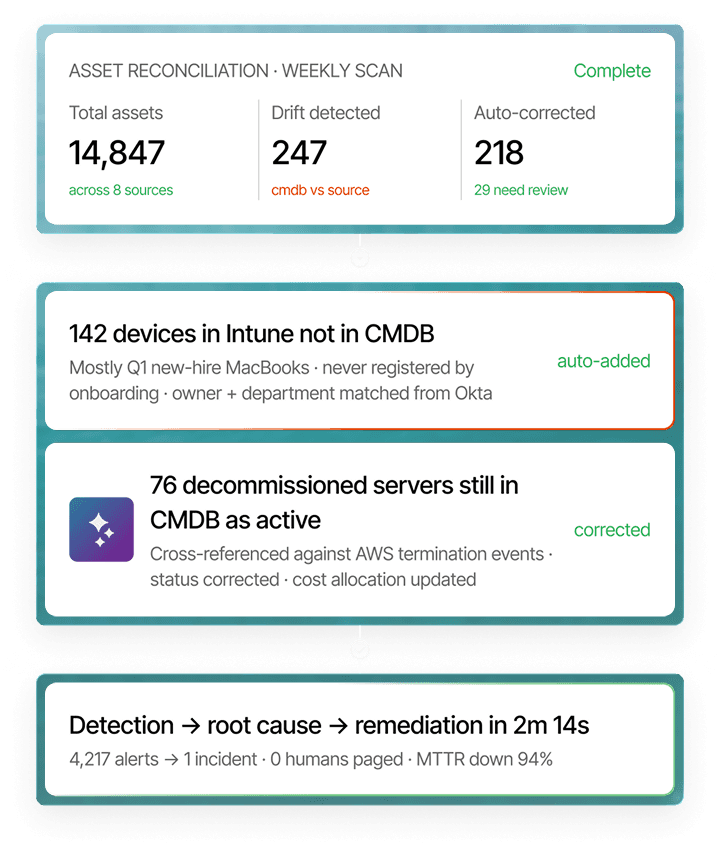
Enterprises can't see all their hardware, software, SaaS, and cloud assets. Data is fragmented across ServiceNow CMDB, Intune, Okta, AWS, Azure, and a dozen other tools. The CMDB goes stale. Agents reconcile asset data across every source continuously, flag drift, and keep the record accurate without an admin army.
Cross-system asset reconciliation
ServiceNow CMDB, Intune, Okta, Jamf, AWS, Azure, GCP. Every asset record cross-referenced and reconciled. Drift flagged with the conflicting sources cited.
CMDB accuracy maintained continuously
New devices, decommissioned servers, changed owners, expired warranties. The CMDB reflects reality at all times, not once a quarter after a manual audit.
Software license compliance
Installed software vs licensed entitlements. Over-deployed and under-utilized flagged. Audit-ready report generated on demand.
Lifecycle management automated
Warranty expiration, lease end, refresh cycles. Agent triggers the replacement workflow, the procurement request, and the decommission ticket at the right time.


Cloud spend is one of the largest and most opaque expense lines. CPU utilization averages 8%. Memory averages 20%. Engineers won't act on dashboards. Agents rightsize, kill idle resources, optimize reservations, and rebalance workloads continuously. The savings show up on the invoice.
Idle and underutilized resource detection
Instances running at 3% CPU. EBS volumes unattached. Load balancers with no targets. S3 buckets with lifecycle policies never applied. Found and flagged.
Rightsizing with change execution
Not a recommendation dashboard. The agent proposes the resize, routes for approval, and executes the change in the cloud console. Done.
Reservation and savings plan optimization
Agent analyzes usage patterns across regions and instance families, models RI/SP coverage, and recommends the purchase. Commitment waste eliminated.
Cost allocation and team attribution
Untagged resources identified and tagged. Cost attributed to team, product, and customer. Finance gets the breakdown without a monthly spreadsheet exercise.
MORE IT WORKFLOWS
These run on the same platform you deploy for the work above. New use cases are configurations, not new products.
Endpoint management & patch automation
Agents inventory, configure, and patch thousands of endpoints across locations. Unpatched systems flagged and remediated continuously. Policy-driven, not ticket-driven. Compliance posture reported in real time.
SaaS management & shadow IT
Roughly 90% of SaaS tools are adopted outside IT. Agents discover every app from identity and network signals, flag unsanctioned tools, and enforce governance. Security, compliance, and spend risk managed from one layer.
Identity governance & access automation
Joiner-mover-leaver flows across Okta, AD, and every SaaS app. Access reviews automated. Orphan accounts terminated. Least-privilege enforced without a quarterly manual campaign.

HOW WE WORK
The Forward Deployed Engineer is not a consultant. They are a builder embedded in your team, working inside your infrastructure. They leave when you're live, not when their contract ends.
Connect
A Forward Deployed Engineer maps your IT stack on-site. ServiceNow, Jira, PagerDuty, Datadog, Okta, Intune, AWS, Azure, GCP, Slack. Inside two weeks the context spans every system, every alert source, and every asset. No data movement. No replatform.
Build
Agents configured against your actual workflows. Your escalation matrix. Your runbooks. Your change approval policies. Your cloud tagging taxonomy. Built-in compliance protocols on every agent. Every action logged, structured, and auditable.
Deploy
Your agents are live. Tickets resolving. Alerts correlating. Assets reconciling. Cloud costs optimizing. The FDE stays on-site through deployment and handoff. Your team owns the platform and the agents.
FAQS

" height="24px" id="W5lcXBfNC" width="24px"/></g></svg>)