


The ERP doesn't talk to the WMS. The WMS doesn't talk to the quality system. The quality system doesn't talk to procurement. Operations teams spend more time reconciling data between systems than running actual operations. Procurement chases suppliers across email. Finance closes the books by re-keying numbers into a spreadsheet. AI that just searches your docs won't close that gap.
Critical systems in the average mid-market manufacturer. ERP, WMS, QMS, MES, PLM, TMS, procurement. Each with its own data model, its own vendor master, its own version of the truth.
Software applications in the average manufacturer. ERP, WMS, MES, QMS, PLM, TMS, CRM, procurement, and everything between them.
of manufacturing leaders say they cannot get a real-time, cross-plant view of operations. The data exists. It's just in different systems.
A container from Shenzhen clears customs two days late. The agent catches the delay, contacts the carrier, adjusts the receiving schedule in the WMS, updates the ERP, and notifies procurement. One pass across every system.

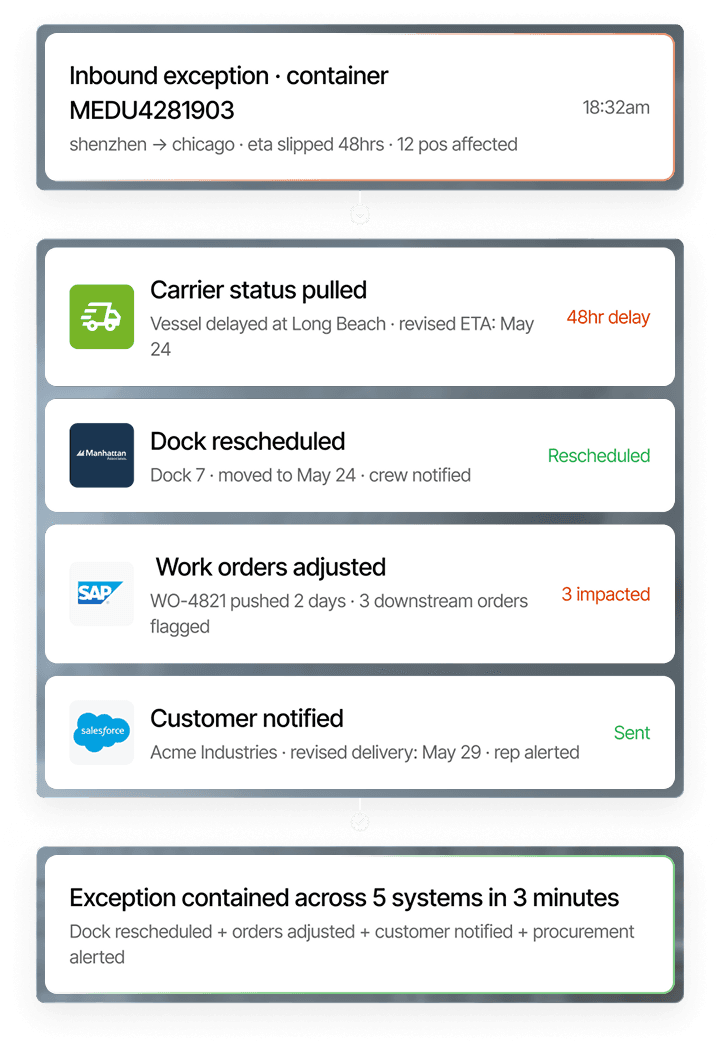
Carrier tracking and delay detection
Check in with carriers milestones, collect live ETAs, flag exceptions the moment they surface. Across TMS, carrier APIs, and ERP.
Inbound freight exception handling
Late shipment cascades into receiving, production schedules, and customer delivery. Agent adjusts the WMS schedule, updates the ERP, and notifies downstream teams.
PO reconciliation
Match purchase orders against goods receipts across ERP and WMS. Flag quantity mismatches, short ships, and damaged goods before AP processes the invoice.
Restock and replenishment triggers
Monitor real-time inventory levels across plants. Trigger reorders when stock hits threshold. Pull lead times from the supplier portal, not from a spreadsheet.
FINANCE & AP


Your AP team re-keys data from three ERPs into one spreadsheet to close the books. Agents pull the PO from SAP, the goods receipt from the WMS, and the vendor invoice from the portal. Three-way match, flagged discrepancies, routed for approval.
3-way invoice matching
Match purchase order, goods receipt, and vendor invoice automatically across ERP and AP systems. Flag discrepancies for review. This is live at Davante today.
Vendor payment scheduling
Optimize payment timing based on terms, early pay discounts, and cash position. Pull data from AP, banking, and the vendor portal.
Duplicate invoice detection
Catch duplicate or near-duplicate invoices before they clear. Cross-reference across entities when the same vendor bills multiple subsidiaries.
Month-end close acceleration
Automate reconciliation across entities. Flag open items, pull accruals from each ERP, and consolidate. Weeks of close work compressed into days.
Your procurement team mananges 200+ suppliers across 4 plants. On-time delivery, quality rejections, pricing compliance, contract expirations. Agents pull from every system, score every vendor, and flag the problems before they disrupt production schedules.


Vendor performance scoring
Aggregate on-time delivery, quality metrics, pricing compliance across all orders and all plants. Auto-generate vendor scorecards quarterly.
PO creation and routing
Generate purchase orders from demand signals in the ERP. Route for approval based on threshold rules. Track status through fulfillment.
Contract compliance monitoring
Track expiration dates, auto-renewal windows, volume commitments, pricing terms. Alert before a contract lapses or a price increase kicks in.
Supplier communication automation
Chase order confirmations, request updated ETAs, follow up on quality issues. Agents handle the back-and-forth across email and vendor portals.
ENTERPRISE SEARCH


Your operations manager needs yield data from Plant 1 (SAP), Plant 3 (Epicor), and the MES process data for both. Today that's four logins and a spreadsheet. Agents search across all of them in one pass.
Cross-plant operational data
How does Plant 3's yield compare to Plant 1? Pull data from each ERP, normalize across different schemas, return a clean comparison.
SOP and work instruction search
Which SOP applies to this process? Agent searches across QMS, document management, and training records. Returns the current revision, not the one from 2019.
Product and material specification lookup
What's the approved spec for this material? Agent pulls from PLM, checks against the latest engineering change orders, confirms supplier certification status.
Vendor and supplier history
Full supplier profile in one query: purchase history from ERP, quality data from QMS, delivery performance from WMS, contract terms from procurement.
NCR filed on a batch. Today, your quality engineer logs into ETQ, then SAP for the lot history, then the MES for process data, then PLM for the spec. Four systems, four hours. The agent traces the full chain, finds the deviation, and drafts the CAPA.


NCR investigation across systems
Pull the quality record from ETQ, trace the lot in SAP, check process parameters in the MES, verify specs in PLM. Full root cause assembled in minutes.
CAPA generation with root cause tracing
Agent identifies the process deviation, links it to the material lot and supplier, drafts the corrective action with full evidence chain. Routes for quality manager approval.
Lot traceability across production
Trace any material lot from supplier receipt through production and shipment. Which orders used lot RM-2947? Which customers received product from that batch?
Recall readiness and containment
Identify every affected lot, every downstream order, every customer shipment. Agent assembles the containment scope across ERP, WMS, and shipping records.
Audit preparation
ISO 9001, IATF 16949, FDA. Pull certifications, calibration records, training logs, CAPAs, and NCR histories from across every system. Assembled, not hunted.
Your engineer learns your system landscape
Which ERPs run which plants, how materials flow between facilities, where the manual handoffs are. They understand your operations before connecting anything.
They connect SAP, Epicor, Manhattan, ETQ
Read-only first. Context graph builds across ERPs, warehouse systems, quality platforms, and agency search tools. Your IT team reviews every connection.
Agents respect your approval chains
Every agent operates within your existing approval workflows, quality gates, and access controls. Sandbox first. Production after your team signs off.
One engineer. Not a systems integrator.
No $1M Accenture project. No 18-month timeline. One implementation engineer, one platform, live in weeks. Running real operations from day one.
Agents that trace lots, match invoices against BOMs, and investigate NCRs need access to sensitive production data. Rebase runs inside your VPC. Every action auditable. ISO, FDA, IATF compliance built into the architecture.
REBASE DEPLOY • YOUR-VPC
$
rebase init --byoc
>
provisioning in vpc-prod-eu-west-1
✓
control plane installed
✓
data plane bound to your KMS
✓
audit controls enforced
$
rebase status
HIPAA-compliant by architecture
Not a BAA bolted on. The architecture enforces PHI controls at every layer. Zero data retention available. All operational components run directly in your own VPC so no PHI ever leaves your boundary.
AWS
AZURE
GCP
ON-PREM
AIR-GAPPED
Full audit trail on every action
Every lot traced, every invoice matched, every NCR investigated. Logged, append-only, streamable to your SIEM.
SPLUNK
Data Dog
S3
Human-in-the-loop on production actions
Agents check conditions, update inventory, or flag exceptions. The system is human-in-the-loop: users review recommendations before they edit ERP or WMS.
APPROVAL CHAINS
4-EYES
Model-agnostic with data controls
Route agents to any model. Sensitive production data masked when required. Switch models without touching agent logic.
MASKING
BYOK
ROUTING
Sandbox-before-production
Every agent runs in shadow mode first. Reads real data with write-access disabled. Your quality team promotes to production.
SANDBOX
PROMOTION
POLICY
SOC 2
BYOC
ZDR
ISO 9001
IATF 16949
FDA 21 CFR
FAQS

" height="24px" id="W5lcXBfNC" width="24px"/></g></svg>)