

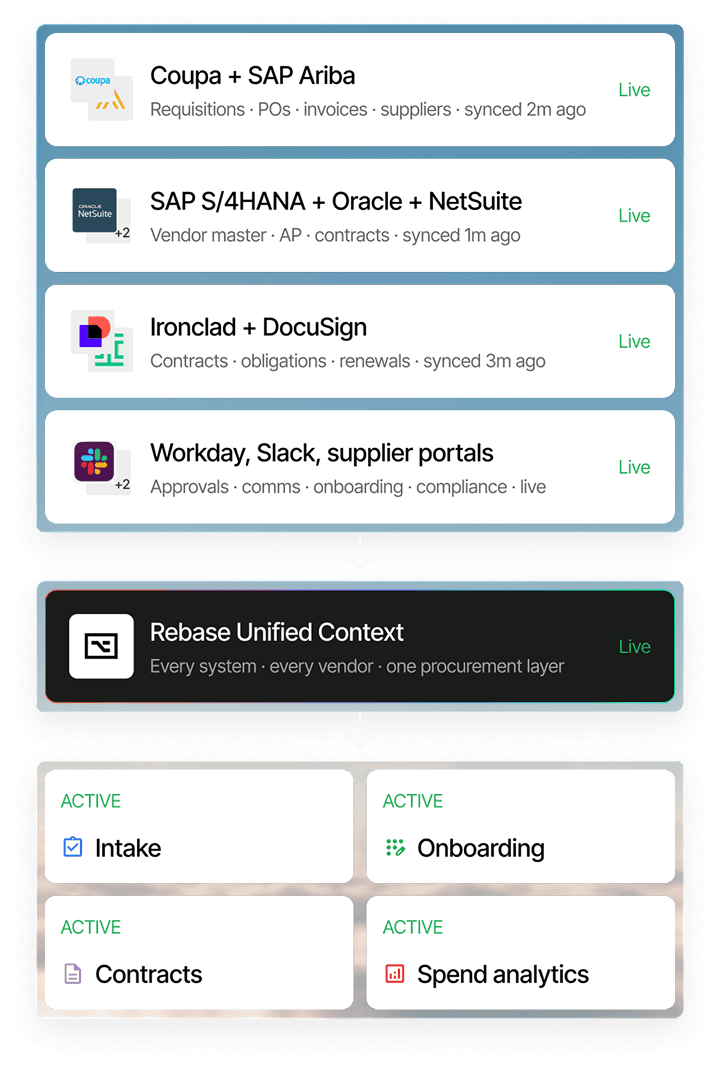
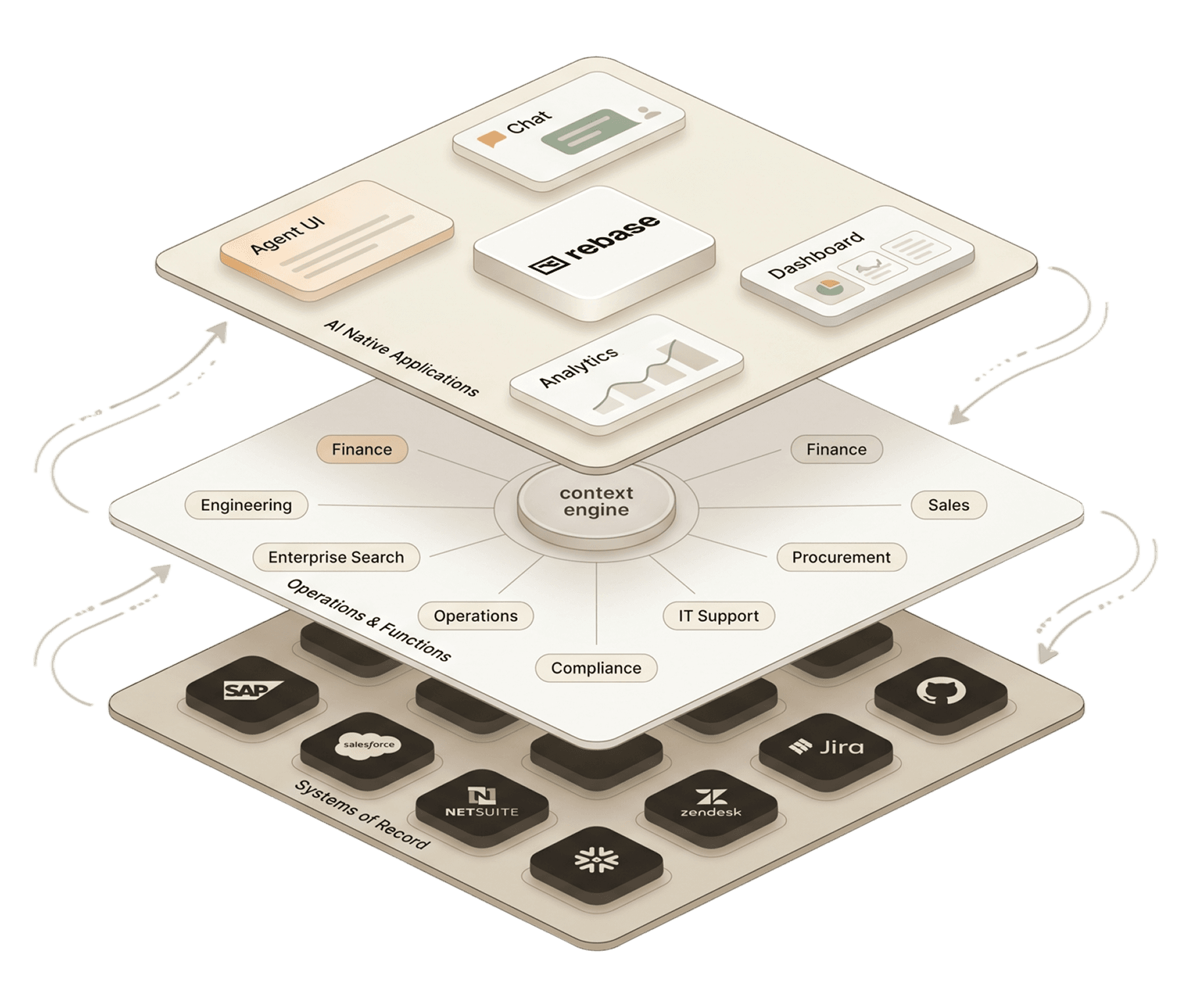
Rebase agents pull live context from every system your procurement team runs on. Coupa, Ariba, SAP, Oracle, NetSuite, Ironclad, DocuSign, Workday, Slack. Then they do the work. Requests routed. Suppliers onboarded. Contracts managed. Spend classified.
Not a dashboard on top of Coupa. The actual operational work.

INTAKE-TO-PROCURE


An employee needs to buy something. Today that request bounces across finance, legal, IT, security, and procurement via email and spreadsheets for weeks. Rebase agents route the request, check budgets and policies, run approvals, and issue the PO in the source system. The procurement team works the strategic sourcing. The intake queue moves.
Single front door from Slack or email
Employee posts a request in natural language. Agent classifies, de-duplicates against existing contracts, and routes to the right workflow. No intake form.
Budget and policy check in real time
Agent checks department budget in Workday, verifies against procurement policy, flags exceptions before routing for approval. No surprises downstream.
Multi-system approval orchestration
Finance, legal, IT security, procurement. Each approver gets the request with the context they need. Sequential or parallel. Escalation if SLA breaches.
PO issued in the system of record
Approved request becomes a PO in Coupa, Ariba, or SAP. Vendor notified. Budget committed. Audit trail saved. Weeks become hours.


Onboarding a new supplier means collecting W-9s, COIs, certifications, banking details, running OFAC and D&B checks, and entering the record into the ERP. Today that takes 6 to 8 weeks. Agents collect the docs, validate every field, screen every list, and create the vendor master record across your systems in days.
Automated document collection
Agent sends the supplier a portal link. W-9, COI, ISO cert, bank letter, diversity cert collected and validated as they arrive. No email chase.
Compliance screening on every vendor
TIN validated against IRS. OFAC/SDN and EU consolidated list screened. D&B financial health checked. Every result cited and logged.
Vendor master created across ERPs
One onboarding creates the record in SAP, Oracle, NetSuite, and Coupa simultaneously. No re-entry. No drift between systems. Golden record from day one.
Risk-tiered due diligence
Low-risk vendors auto-approved. High-risk flagged for manual review with the supporting docs and the screening results attached. Policy cited.
CONTRACT MANAGEMENT

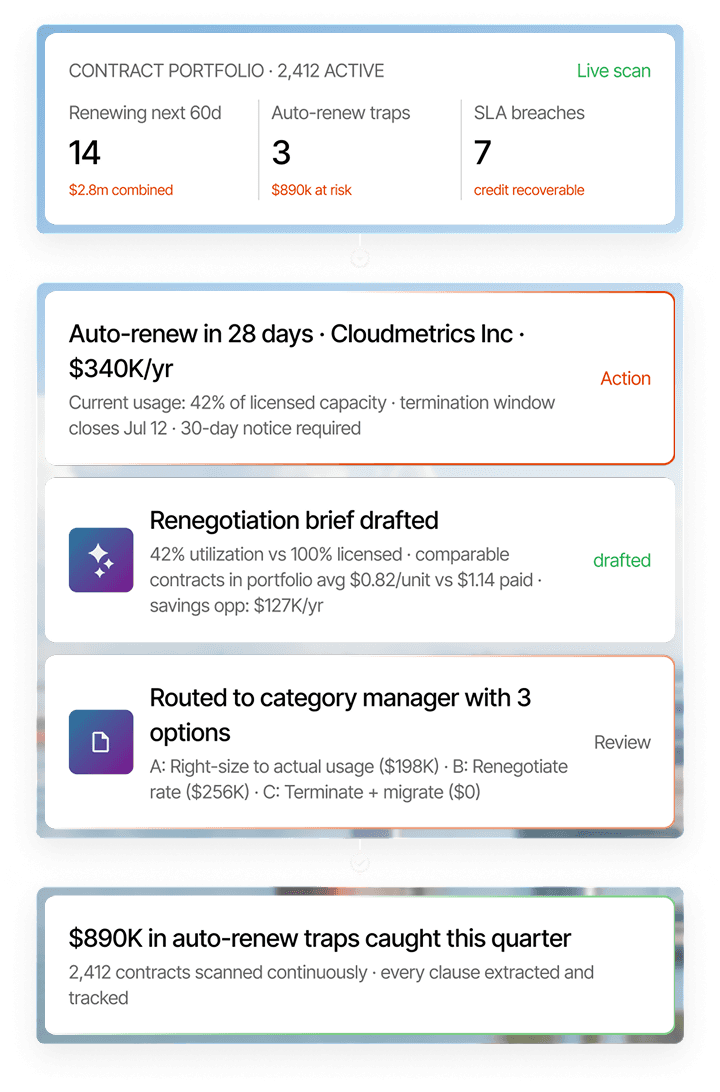
Every dollar in and out flows through a contract, and most of them sit as static PDFs in a repository. Auto-renewals trigger unseen. Obligations go untracked. Agents read every contract, extract the terms, track the dates, and surface the savings before the window closes.
Clause and obligation extraction
Payment terms, SLAs, termination windows, auto-renew clauses, liability caps, exclusivity provisions. Extracted and structured from the actual PDF. Every clause cited.
Renewal tracking with early warning
90, 60, 30-day alerts before renewal deadlines and auto-renew triggers. The alert includes the contract summary, the spend history, and the usage data.
Renegotiation briefs drafted automatically
Agent pulls usage data, market benchmarks, and comparable contracts from your portfolio, then drafts the negotiation brief with the savings opportunity quantified.
Compliance monitoring across the portfolio
SLA adherence checked against actual performance data. Payment terms compared to actual pay cycles. Non-compliance flagged with the evidence and the financial exposure.


Spend data is fragmented across ERPs and entities. Inconsistent supplier names, mismatched category codes, duplicate vendor records. Agents ingest AP data from every system, classify every transaction, de-duplicate the vendor master, and surface the savings the team couldn't see before.
Ingest from every ERP and P2P system
SAP, Oracle, NetSuite, Coupa, Ariba, legacy systems from acquisitions. All AP data in one classification engine. No export/import.
UNSPSC classification at the line level
Every transaction classified to 4-digit UNSPSC. Not just headers. Line items, descriptions, GL codes reconciled. Category managers see real spend for the first time.
Vendor master de-duplication
"Acme Corp," "ACME CORPORATION," "Acme Corp Inc" — same vendor, three records, three payment streams. Agent identifies, merges, and flags for AP correction.
Savings surfaced and routed
Duplicate payments. Off-contract spend. Price variance across entities. Each finding quantified, cited, and routed to the right owner with the evidence attached.
MORE PROCUREMENT WORKFLOWS
These run on the same platform you deploy for the work above. New use cases are configurations, not new products.
Autonomous negotiation
Agents run tail-spend negotiations at scale. Supplier gets a negotiation interface. Agent benchmarks against community data, proposes terms, and closes within your policy guardrails. Category leaders report 2 to 7% savings on addressed spend.
SaaS procurement & license optimization
Agents monitor license usage across every SaaS tool, flag underutilized subscriptions, benchmark renewal pricing against market data, and draft the cancellation or renegotiation before the auto-renew triggers. Most companies overspend on SaaS by 20 to 30%.
Tail-spend management
80% of your vendors represent 20% of your spend and get almost no procurement attention. Agents automate engagement, sourcing, and payment for the long tail without cluttering the vendor master or slowing the strategic team.

HOW WE WORK
A Forward Deployed Engineer maps your stack, configures the agents, and stays embedded with your team. Not a consultant who parachutes in. A builder who stays until the work runs itself.
Connect
A Forward Deployed Engineer maps your procurement stack on-site. Coupa, Ariba, SAP, Oracle, NetSuite, Ironclad, DocuSign, Workday, Slack. Inside two weeks the context spans every system, every vendor, and every contract. No data movement. No replatform.
Build
Agents configured against your actual workflows. Your approval matrix. Your procurement policies. Your vendor classification rules. Your contract terms and renewal calendars. Built-in compliance protocols on every agent. Every action logged, structured, and auditable.
Deploy
Live in production in six to eight weeks. Your FDE stays until the workflows are stable. Then your team owns them. Every interaction continues to improve the system as it runs.
FAQS

" height="24px" id="W5lcXBfNC" width="24px"/></g></svg>)