

You've made 11 acquisitions and inherited 11 systems. The integration takes 18 months with consultants. Rebase connects every ERP, CRM, and ops tool into one context graph. Then deploys agents that run operations across all of them.
Every acquisition adds systems. Nobody removes them. Integration eats 18-24 months. The consulting bill hits $2M before the first workflow is automated. Meanwhile, every acquired company is still running its own ERP, its own CRM, its own processes. People are the middleware.
Of M&A deals fail to create expected value. System fragmentation and slow integration are the top reasons.
Average time for post-acquisition system integration with a traditional systems integrator. That's a third of the hold period.
Typical consulting bill per integration project. Per acquisition. Multiply it by every company you've bought
Every acquired company brought its own ERP, CRM, and HR system. Rebase connects all of them into a single context graph without replacing anything.

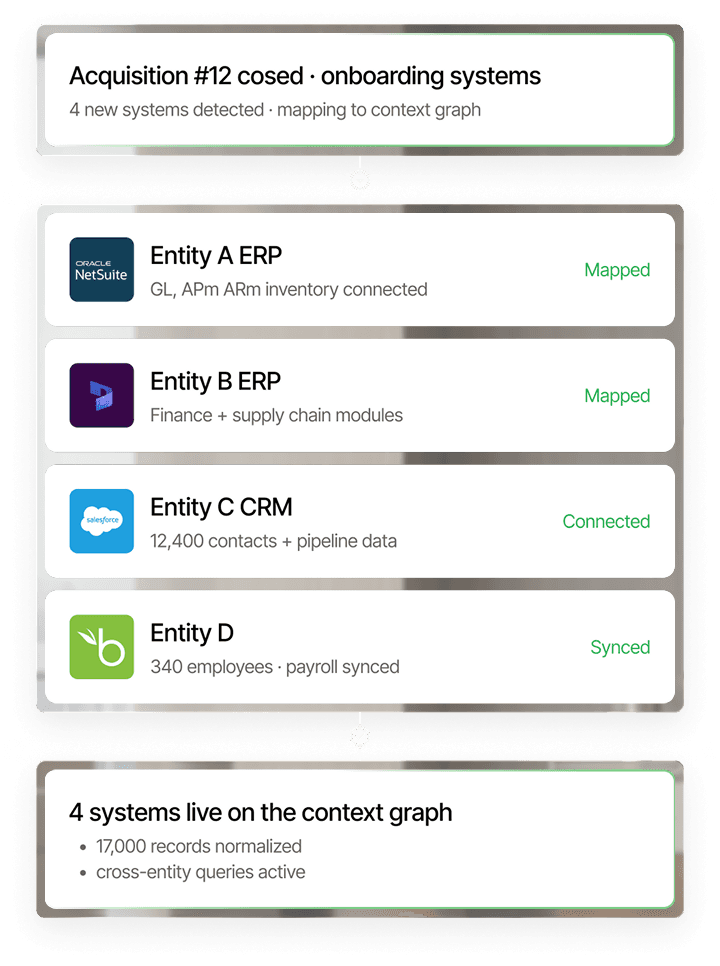
Multi-ERP connection
Connect NetSuite, Dynamics, SAP, QuickBooks, Sage however many ERPs you inherited into one live graph.
CRM unification
Salesforce at company A, HubSpot at company B, Zoho at company C. Agents see customers across all of them.
HR system bridging
Workday here, BambooHR there, ADP somewhere else. Agents run onboarding and compliance across all.
Data normalization
Different chart of accounts, different naming conventions, different data models. The context engine normalizes it.
ENTERPRISE SEARCH


Every acquired company has its own docs, wikis, policies, and tribal knowledge. Agents search across all of them in one query. No separate search product needed.
Cross-entity knowledge search
Search across SharePoint, Confluence, Google Drive, and every system from every acquisition. One query.
Policy and procedure lookup
Which refund policy applies to this customer? Depends on which acquired entity they came from. The agent knows.
Employee self-service
New hires find answers from any entity's knowledge base. Benefits, processes, tools — without knowing which legacy company owned what.
Institutional memory preservation
When acquired company employees leave, their knowledge stays in the graph. Context survives turnover.
Every acquired entity runs a different ERP with a different chart of accounts. Agents match invoices, reconcile across entities, and produce consolidated reports.


Cross-entity invoice matching
Cross-entity invoice matching 3-way match across 4 different ERPs. PO in NetSuite, receipt in Dynamics, invoice in Sage. Agents connect the dots.
Consolidated month-end close
Pull actuals from every entity's ERP, normalize to a standard chart of accounts, produce one consolidated view.
Intercompany reconciliation
Transfers between acquired entities that show up differently in each ERP. Agents match and eliminate.
Board-ready reporting
Your board wants one view across all entities. Agents pull live data from every ERP, not a 2-week Excel exercise.
OPERATIONS


You have a standard playbook. Every company you acquired ignores it because their systems can't support it. Agents enforce standard processes without replacing anyone's tools.
Vendor onboarding standardization
Same intake, same compliance checks, same approval chain — regardless of which entity's ERP the vendor lands in.
Procurement workflow enforcement
Agents apply threshold-based approvals, preferred vendor lists, and contract compliance across every acquired entity.
Employee onboarding across entities
New hire at entity G gets the same onboarding experience as entity A — even though they run different HR systems.
Compliance and audit standardization
Same audit trail format, same access controls, same reporting cadence. Across every entity. Automatically.
11 acquired companies means 11 customer bases, 11 support systems, 11 sets of processes. The customer just wants their problem solved. Agents unify the context.


Cross-entity customer lookup
Customer came from AcademyPro (acquired 2023). Support rep sees their full history without switching systems.
Unified ticket routing
Regardless of which entity the customer belongs to, the ticket routes to the right team with full context.
Post-merger account migration
Customers from acquired entities get migrated smoothly. Agents handle access, billing, and communication.
Service level standardization
Same response times, same resolution process, same quality regardless of which legacy entity the customer came from.
FDE maps the post-acquisition landscape
Which entities run NetSuite, which run Dynamics, which are still on QuickBooks. What overlaps. What's missing. The FDE documents it all in week one.
They connect every ERP, CRM, and ops tool
Read-only first. Context graph builds across entities. No rip-and-replace. Every legacy system stays exactly where it is.
Agents go live in weeks, not quarters
Invoice matching, vendor onboarding, customer migration — sandbox first, production when proven. FDE stays until outcomes are real.
One engineer replaces the integration consultant
No $2M Accenture engagement. No 18-month timeline. One FDE, one platform, every system connected.
Agents that read financial data from 4 ERPs, search employee records across 3 HR systems, and resolve customer issues across legacy CRMs need access to sensitive data. Rebase runs inside your VPC.
REBASE DEPLOY • YOUR-VPC
$
rebase init --byoc
>
provisioning in vpc-prod-eu-west-1
✓
control plane installed
✓
data plane bound to your KMS
$
rebase status
Deploys inside your perimeter.
Control plane, data plane, model gateway. All co-located with your data. Nothing leaves.
AWS
AZURE
GCP
ON-PREM
AIR-GAPPED
Full audit trail on every agent action
Every PO matched, every carrier contacted, every SKU reallocated. Logged, anonymized, streamable to your SIEM.
SPLUNK
Shopify
SAP
Human-in-the-loop on write actions
Agents that update your ERP, send vendor disputes, or push pricing changes require approval before execution. You set the thresholds.
APPROVAL
SLACK
THRESHOLDS
4-EYES
Model-agnostic gateway
Route any agent to any model. Anthropic, OpenAI, Mistral, your own. Switch without touching agent logic.
ROUTING
FALLBACK
BYOK
Sandbox before production
Every agent runs first in a shadow sandbox with write-access disabled. Promote to production only after policy review.
PROMOTION
4-EYES REVIEW
POLICY
OPA
SOC 2 TYPE II
BYOC
ZERO DATA RETENTION
PCI-DSS
GDPR
CCPA
FAQS

" height="24px" id="W5lcXBfNC" width="24px"/></g></svg>)